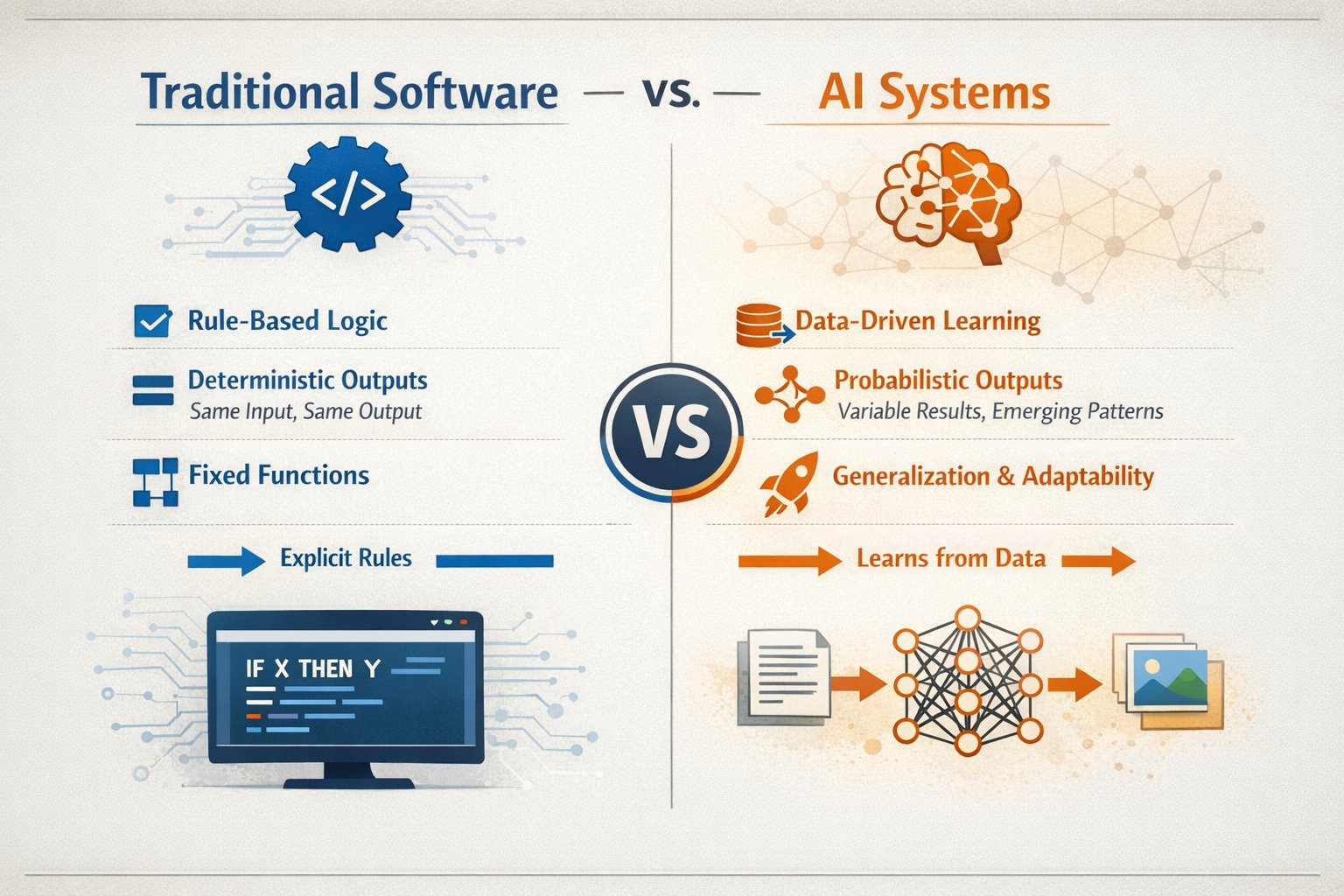
Artificial intelligence is a way of building software that learns patterns from data rather than following only rules explicitly written by a programmer. In that sense, AI is not just a new feature set on top of software; it is a different computational paradigm.
A useful intuition comes from human learning. A child does not learn language by first memorizing a formal grammar book. The child hears thousands of examples, absorbs statistical patterns, and eventually produces sentences they have never heard before. AI systems work in a similar way. Rather than being programmed with every rule in advance, they are trained on data and learn representations that allow them to make predictions, generate outputs, or take actions in situations they were not explicitly programmed for.
Traditional software works differently. In classical software, developers encode logic directly: if X happens, do Y. If a transaction exceeds a threshold, flag it. If a user clicks a button, trigger a workflow. The system is fundamentally rule-based, deterministic, and bounded by what its creators specified. It performs well when the problem can be clearly defined in logic. Its behavior is legible because the instructions are legible.
AI changes that. Instead of specifying the logic step by step, developers specify an objective, training process, and operating constraints. The system then learns the internal logic for itself. This makes AI extraordinarily powerful on problems that are hard to reduce to explicit rules, such as language, vision, ranking, generation, prediction, or planning. But it also makes AI products fundamentally different to build, evaluate, and govern.
There are several important differences.
First, AI is data-driven, whereas traditional software is rule-driven. In traditional systems, the primary source of behavior is code. In AI systems, the primary source of behavior is a combination of model architecture, training data, and optimization. Code still matters, but it is no longer the full specification of system behavior. This creates a new product reality: improving the product often means improving data quality, retrieval context, post-training, or evaluations, not just shipping more logic.
Second, AI is probabilistic, whereas traditional software is deterministic. Traditional software is expected to produce the same output for the same input, assuming the environment is unchanged. AI systems instead produce outputs based on learned probability distributions. Even when they appear fluent and confident, they are making best-fit predictions rather than executing exact symbolic truth. This is why AI can be useful in open-ended tasks, but also why it can hallucinate, drift, or fail in ways that are harder for users to detect. A calculator returning the wrong answer is obviously broken. A language model returning a plausible but incorrect answer is more dangerous, because it can preserve the appearance of intelligence while violating correctness. That changes the design challenge from simple functionality to calibrated trust.
Third, AI generalizes in ways traditional software usually cannot. Traditional systems are narrow: they do what they were designed to do, and little beyond that. AI systems can often handle cases never explicitly enumerated in advance. A modern model may be able to write a strategy memo, summarize a legal document, reason about a robotics workflow, and critique its own answer, even though no engineer manually authored rules for each of those tasks. This ability to generalize is what makes foundation models so economically and strategically important. The same model can power many experiences. But this generality also means behavior can be emergent, uneven, and difficult to fully predict. Capability is broader, but control is looser.
These differences have major implications for product development.
In traditional software, the core job is often to define logic, workflows, state transitions, and edge cases. In AI products, the job shifts toward shaping behavior rather than specifying it exhaustively. The product team is no longer only designing features; it is designing a system of inputs and constraints. That includes training data, prompt design, retrieval architecture, fine-tuning strategy, model selection, tool use, guardrails, memory, and evaluation. The craft becomes less about "Did we implement the logic correctly?" and more about "Under what conditions does this system behave well, fail poorly, improve over time, and earn trust?"
This also changes how quality is measured. Traditional software is often evaluated through correctness and reliability against predefined requirements. AI systems require evaluation across distributions: accuracy, groundedness, latency, consistency, toxicity, bias, cost, user satisfaction, and task success under real-world variation. In practice, this means evals become a first-class product discipline, not a supporting function. You are not simply testing whether the system works. You are continuously characterizing how it behaves.
There are also infrastructural differences. Traditional software can often run cheaply on CPUs with predictable performance envelopes. Advanced AI systems, especially foundation models, are heavily dependent on specialized hardware such as GPUs or other accelerators. That has consequences for cost structure, latency, product design, and business model viability. A traditional feature might have near-zero marginal cost at scale. An AI feature may incur meaningful per-query inference cost, variable response times, and quality tradeoffs based on model size or context length. Product decisions therefore become tightly coupled with compute economics. Intelligence is not free; it is bought through training and inference spend, then rationed through product choices.
Context also matters in a new way. Traditional software generally operates on explicit state and structured inputs. AI systems, especially language models, are highly sensitive to the context window, instructions, retrieved information, tool outputs, and surrounding conversation. The same model can produce dramatically different outcomes depending on what information is in scope. As a result, context engineering becomes a core part of product design. The quality of the system is often a function not only of the model itself, but of whether the right knowledge, memory, and constraints were made available at the right moment.
The deeper implication is that AI products are not just software products with smarter outputs. They are adaptive systems whose behavior emerges from the interaction of models, data, context, interfaces, and feedback loops. That requires a different posture from product leaders. You have to think simultaneously about capability, trust, economics, human factors, operational monitoring, and iterative learning.
So, what is AI? At its core, AI is software that learns.
And how is it different from traditional software? Traditional software encodes rules; AI encodes behavior indirectly through data, optimization, and context. Traditional software is deterministic, explicit, and narrow. AI is probabilistic, learned, and generalizing. That makes it more powerful, but also harder to control. Which is why building great AI products is not only a technical problem. It is a systems design problem, a product judgment problem, and increasingly, a governance problem.