My husband and I have been fully nerding out over models, architectures, and all things AI. After overhearing way too many of these conversations, my kids got curious. One day my older one finally asked, "What is this network thingy you two keep talking about?"
Honestly, that was my cue to figure out how to explain neural networks without sounding like I was giving a TED Talk at the dinner table. So I asked: when you see an animal, how do you know if it is a cat and not a dog? And how did you even learn that in the first place?
The conversation was back and forth and I wish I had recorded it because it was quite intriguing — but here is the TLDR.
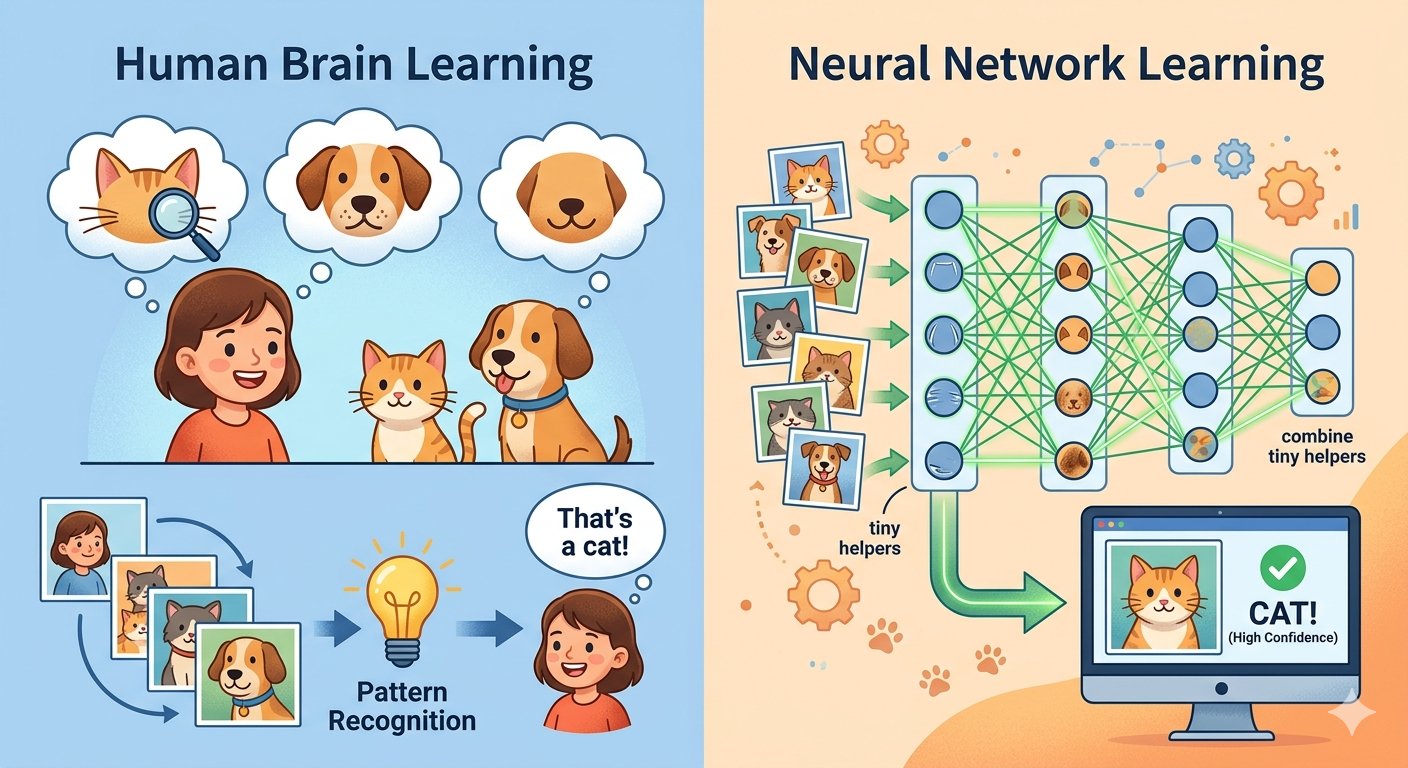
You learned it by seeing lots and lots of animals over time. Maybe you saw cats in books, in real life, in cartoons, or in photos. After seeing many examples, your brain started noticing patterns. Cats often have whiskers, pointy ears, smaller faces, soft paws, and long tails. Dogs often have longer noses, bigger paws, different ears, and different body shapes. Your brain learned from all those examples and got better at telling them apart.
Your brain has tiny helpers called neurons. Each neuron helps notice a different little clue. One neuron may help notice the shape of the ears, another the whiskers, another the face shape, and another the way the animal moves. Each neuron does one small part of the job, and together they help your brain put all the clues together very fast and say, "This is a cat, not a dog." To do the whole job, you need a network of neurons, not just one.
In the same way, a computer can learn using a neural network. A neural network is a team of tiny helpers inside a computer. When you show a computer many pictures of cats and dogs, it starts learning the patterns that make a cat look like a cat and a dog look like a dog.
Each tiny helper in the computer, called a neuron, looks for one small clue. One may look for pointy ears, another for whiskers, another for fur, and another for tail shape. Then all the tiny helpers work together very fast to help the computer figure out, "This looks like a cat, not a dog."
So both you and the computer learn the same way. Your brain learns by seeing cats and dogs again and again over time. The computer learns by being shown many pictures again and again. Then both use clues and patterns to tell the difference.
That is a neural network. A team of tiny helpers, each noticing one small thing, all working together to understand the world.